West Bengal, a culturally rich state in eastern India, is divided into five administrative divisions. These divisions help in the smooth governance and efficient management of resources, development, and public services across the state. The administrative structure of West Bengal is organized into 23 districts, each contributing to the state’s economy, culture, and social fabric.
In this post, we’ll explore each of the five administrative divisions and their respective districts, highlighting the diverse characteristics of these regions.
Administrative Overview of West Bengal
West Bengal is one of India’s most strategically located states, serving as a gateway to Northeast India and neighbouring countries such as Bangladesh, Nepal, and Bhutan. The state’s administrative structure is designed to ensure efficient governance, public service delivery, law enforcement, infrastructure development, and regional planning across its diverse geographical regions.
- Total Administrative Divisions: 5
- Total Districts: 23
- Capital City: Kolkata
- Largest Metropolitan Area: Kolkata Metropolitan Region
- Official State Website: wb.gov.in
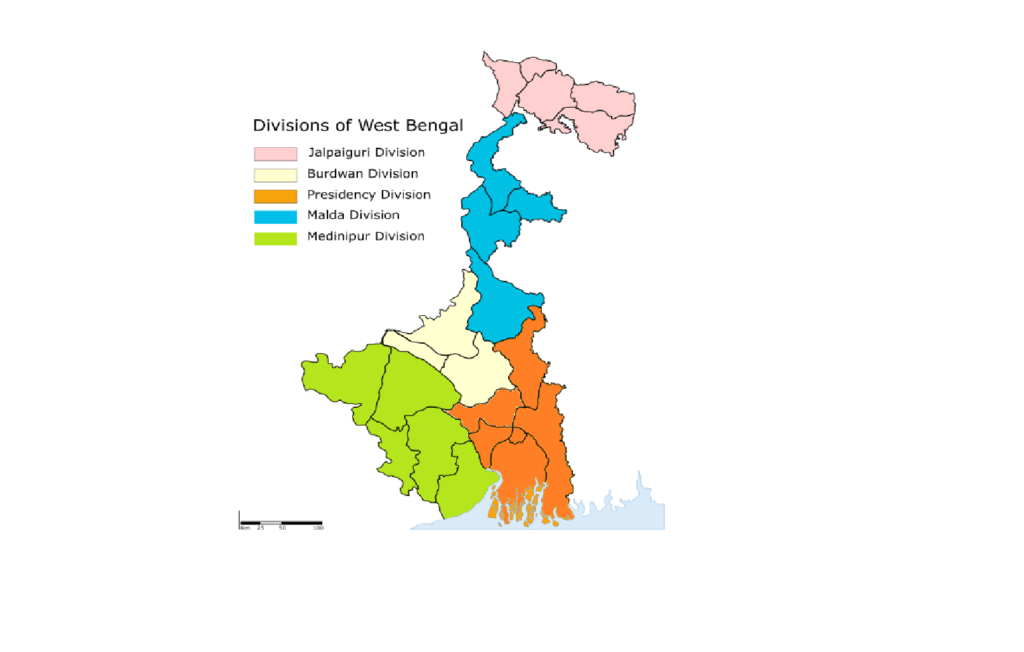
Presidency Division
The Presidency Division is the most urbanized and culturally significant region of West Bengal. It includes Kolkata, the state capital, which is a major center of commerce, education, and culture in eastern India. The surrounding districts also contribute to the state’s development and play a crucial role in its economy.
Districts in Presidency Division:
Kolkata is the heart of the division and a major cultural hub, known for its colonial architecture, theaters, and art galleries. The districts of Howrah, Nadia, and North 24 Parganas offer a balance of urban and rural landscapes, while South 24 Parganas is home to the famous Sundarbans mangrove forest, a UNESCO World Heritage site.
Medinipur Division
The Medinipur Division is located in the southwestern part of West Bengal and is known for its rich agricultural lands and vibrant rural life. It is a region that showcases the state’s natural beauty, with forests, rivers, and extensive farmlands.
Districts in Medinipur Division:
The division plays an important role in agriculture, with a focus on rice, jute, and fish farming. Jhargram has become an emerging tourist destination, famous for its forests and tribal culture. Purulia is famous for its rich cultural heritage and traditional dance forms, such as Chhau Dance.
Bardhaman Division
The Bardhaman Division is an industrial and agricultural powerhouse. It is an important center for both coal mining and agriculture, especially in districts like Birbhum and Hooghly. This region is also significant for its historical and cultural sites.
Districts in Bardhaman Division:
The Bardhaman districts are historically significant and known for agriculture, while Hooghly has a blend of rural and industrial landscapes.
Malda Division
Located in the northern part of West Bengal, the Malda Division is known for its agriculture, particularly mango cultivation. The division also has a historical legacy, with many monuments and relics from different eras.
Districts in Malda Division:
Malda is famous for its delicious mangoes, particularly the Langda variety, and its historical significance with ancient mosques and buildings. Murshidabad is known for its Mughal architecture, while Uttar Dinajpur and Dakshin Dinajpur are important agricultural hubs.
Jalpaiguri Division
The Jalpaiguri Division is located in the northernmost part of West Bengal, bordering Nepal, Bhutan, and Bangladesh. It is known for its scenic landscapes, tea gardens, and the Himalayan foothills.
Districts in Jalpaiguri Division:
The Darjeeling district is world-famous for its tea plantations and breathtaking views of the Himalayas, including the iconic Kangchenjunga peak. Kalimpong and Jalpaiguri are known for their rich biodiversity and eco-tourism. Cooch Behar and Alipurduar offer picturesque landscapes, along with several wildlife sanctuaries.
West Bengal’s five administrative divisions—Presidency, Medinipur, Burdwan, Malda, and Jalpaiguri—each play an essential role in the state’s economic, cultural, and social development. With a total of 23 districts, the state offers a rich diversity in terms of geography, economy, and heritage. Whether it’s the bustling city life in Kolkata, the rural charm of Medinipur, or the natural beauty of Jalpaiguri, each division contributes uniquely to the state’s identity.
Last updated on 06th June 2026